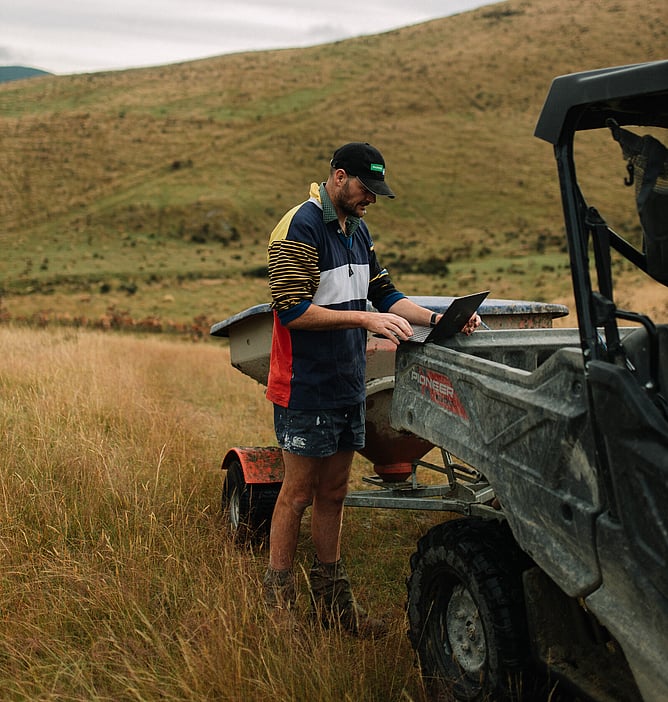
Head of Sales and Marketing, Russell MacKay, has a fifth-generation family sheep and beef farm near Queenstown. Here's his farming update as we get into the midst of autumn after a strange summer.
Poplars begin their chameleon impersonation with a tinge of amber. Silent dewy mornings broken by roaring stags. Crisp nights tell me that yet again, I'm a tad late getting firewood split.
Kia ora rural New Zealand, autumn has crept up on us.
I think the change has caught people off guard as much of the country did not really have a summer in terms of heat and lack of moisture. Most of the country had more rain than you can shake a stick at; dusty gravel roads were few and far between. This was due to a La Niña weather pattern (tropical rain coming from the east). Parts of Hawkes Bay got 150% of the average summer rainfall in December alone.
It should be noted though, that rainfall was patchy throughout the nation; where I am in Northern Southland, we were actually a bit dry mid-December through to the tail end of January. Not a drought, but still a moisture deficit. Further towards the coast, they couldn't get a tractor in paddocks. I spent a fair bit of time in Northland over the summer and I have never seen so much feed in Te Tai Tokerau as a whole as they have had with the continuous dumps of summer rain. But in the same breath, there was the odd valley that seemed to be on the edge of storms and dried out.
Overall, New Zealand has had a bloody wet summer. Not good for holiday making and cricket, but fantastic for growing pasture. This has led to some interesting trends:
Store markets have been nuts. Good luck buying store lambs and cattle – prices have been flaming hot in the saleyards/on farm sales. There a mix of reasons for this: strong on hook prices (we will get to that), shortage of stock in general in the country, and everyone (for the most part) has feed. Usually in Southland, we buy store lambs from North Canterbury/Marlborough when they dry up, but they have had a fantastic growing season and have finished their own stock. Even Central Otago looked like Southland and farmers who are traditionally breeders have turned to finishing. With the extra feed around, you need something to convert it to protein.
Meat processors are begging for your product. There is a shortage of red meat in New Zealand (and worldwide – again, we will get to that); in particular sheep numbers are at a historical low. This, coupled with farmers holding onto stock to eat the pasture, means meat companies have been paying an arm and a leg to fill orders. Lambs for over $200 is insane. Most farmers have the opinion it won't last, but are enjoying is it while it does.
Dairy production is up, and cost structures are lower in some areas. Dairy farmers have been able to produce the same amount of milk with less supplementary feeding, irrigation and nitrogen. Again, this is a generalised statement, but most dairy farmers have had a satisfactory season.
It was good for pasture, terrible for everything else. I really feel for the arable producers in Canterbury – what a dog of a season you guys have had. Getting crops to a suitable moisture content has been a waiting game, meaning farmers have been taking it off a bit green and having to pay for drying.
So what else has been going on outside of weather chat? Well, a lot both domestically and overseas. Every morning I check the news just to make sure the world hasn't blown itself up. Here are some of my thoughts in no particular order:
Wool comeback? We have gone over $5/kg for the first time in 10 years, meaning that some farmers are actually making a profit after shearing! Yes, you heard me. Getting shearers (and dry ewes this year!) has been an issue. I spoke to Rob Hewitt a couple of years ago as he got involved with wool works, and he told me that sheep farmers who went to shedding breeds were to regret it. Was he right? Or is this a 10 steps back and 1 step forward situation?
Fonterra asset sell down: A staggering 98% of shareholders voted in favour of selling Mainland Group for $4.22 billion, with $2/share going to farmers (tax free). In all honesty, the result surprised me. For decades we have been told that New Zealand is too small to be caught in the commodity cycle, we need to be focused on value add, build on our brands etc. In many ways, selling off Mainland seems to be contrary to this. I thought it would be a 'yes' vote, but 98% is incredibly overwhelming. But in all honesty, coming from a sheep farmer, if my meat company offered me $2/share tax free for doing nothing, it would be hard to turn down even for the strongest of ideals.
In relation to the above, what is the money going towards? You may remember in a previous newsletter I referenced a BakerAg article which said 75% of farmers they surveyed were going to put the capital toward further debt reduction. Granted, it was a small survey, but I'm sure banks are scratching their heads as to how to make farmers borrow more. A heap of debt has been repaid by dairy farmers over the past couple of years even before this payout. For the good of New Zealand farming, I hope a good chunk of the money stays within the industry. We can't have every Fonterra shareholder put it towards a bach in Taupo or a crib in Wanaka!
World meat shortage: A lot of western farming nations are still struggling to rebuild breeding stock numbers. Both Australia and USA can't seem to get over the wake and this has been due to drought, feed costs and free market forces. Hold onto your Weet-bix, because this one will have you spitting them out: some feedlots in the States are slaughtering their R1 and R2 heifers for patties (which were bred to be replacements). They are then live importing R1 and R2 heifers internationally, mainly from Australia, as it makes more financial sense for both countries to do so, despite both nations’ beef breeding stocks running low. I think South American beef farmers are quietly rubbing their hands together. These pressures should keep meat prices strong for the foreseeable future, but not many are budgeting on $200/lamb.
Middle East flow on effects: It is so easy to go down a rabbit hole on this one, so I'll keep it to the known facts and keep Epstein out of it! Just like covid, we now realise we are at the end of the supply chain line and getting stuff to our island nation is hard when there is any sort of international disruption. As I write this we have 17 days’ worth of diesel in the country. I don't need to explain why this is an issue for farmers, but the flow on effects are far and wide. Fertiliser prices have already gone up, with Ballance announcing Urea and SustaiN are both increasing by $90 a tonne to $1075/t and $1124/t respectively. DAP is up by $75/t to $1603/t and the price of super has lifted by $35/t to $549/t.
As a final reality check to end on in relation to the previous point, it’s easy to focus on the fuel situation as dire, and for a lot of businesses, it definitely is. But I would rather be in New Zealand with a fuel shortage than be anywhere remotely close to the Middle East right now. This is still a fantastic country, especially for making world class food.
Until next time.