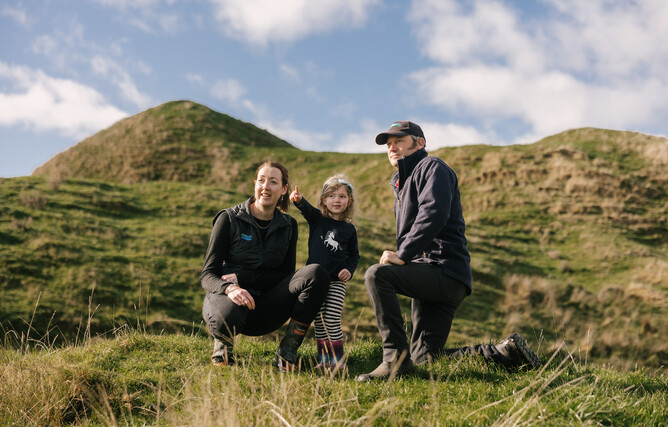
Erica van Reenen is a rural consultant, red meat farmer and the very deserving winner of the 2025 FarmIQ Systems Rural Professional of the Year Award.
She grew up in Wanaka, the daughter of a vet, and was sure she would follow in her father's footsteps – that is, until a few weeks into her first semester at Massey when she realised it wasn’t really for her.
“I was exposed to a whole lot of other options at that point, so I changed to ag and definitely no regrets on that front – I still enjoy working with vets, but I’m not one,” she laughs.
Erica says the opportunities within ag to delve into landscapes, people and animals with a much broader lens was appealing, and it gave her the chance to further her passion for the environment through completing ecology and conservation papers.
Once she had finished her bachelor’s, Erica completed a master’s where she looked at merino wool production, saying it gave her deep research skills, the ability to question things and to think critically.
After university she worked for MAF (now MPI) and Beef + Lamb NZ, honing her skills at the juncture of farming and government. At Beef and Lamb NZ, she jumped at the chance to do on-farm extension work, acknowledging that “the political cycle gets a bit wearying when you've got a passion for agriculture as opposed to a passion for policy.”
Ten years ago, the opportunity arose to partner with James Allen and his fellow shareholders to get AgFirst Manawatu-Whanganui off the ground and Erica was thrilled to take it up. As well as running the local branch, she chairs AgFirst New Zealand and runs a sheep and beef farm with her husband in the mighty Rangitīkei.
Erica believes that such a varied education and work history serves her well as a rural advisor, where clients come to her with all sorts of challenges; she relishes thinking outside the box and looking at the bigger picture to determine the best outcomes for them, their farm businesses and their local environments.
An average workday for Erica isn’t very average at all, with her work varying depending on what projects she’s got on the go. She explains her projects as “serving a greater industry need” while usually getting to collaborate with individual farmers as part of their delivery.
“Whether it's for case studies or for testing lines of inquiry or working with policy folks in Wellington…I get to go to every far-flung corner [of the country].
“One thing I really love is when I get to work in a team of people who bring different skills, so they're in different parts of agribusiness and we get to all sit around the table and solve wicked problems together,” says Erica.
A full-circle moment
Erica’s Rural Professional of the Year win was announced at the Institute of Rural Professionals (previously NZIPIM) conference in Christchurch this August, where she said it was a real honour to be recognised by her peers and to know that the work she does is valued.
The award is a full-circle moment for Erica, who was runner up for the FARMAX Emerging Rural Professional of the Year Award in 2014; to win the main award a decade later shows her dedication to supporting Kiwi farmers and her passion for the industry as a whole.
Erica is using the prize money to complete the Agribusiness Seminar programme at Harvard Business School next month, in what is sure to be a shock to the system going from a hot Kiwi Christmas to Boston’s January average of -2°C.
The Agribusiness Seminar programme encourages attendees to think on their feet and sharpen their analytical skills, covering topics such as the evolving global food system, navigating uncertainties around tariffs and trade policies, and addressing climate risk and environmental pressures.
“It's a case study executive leadership programme that's very highly regarded and recommended by some industry leaders who I have a great deal of respect for,” explains Erica. “I’m very excited.”
“I think for me that kind of sums up the role of rural professionals: we have to be really broad in our thinking to be able to serve very specific needs at all levels of our supply chain...We need that critical thinking lens and we’re not necessarily always telling people what they want to hear, but we’re sitting alongside them to navigate the challenges that we've got and try to flip it into opportunity."
- Erica van Reenen, AgFirst
A few hard truths
Since winning the award, Erica has been reflecting on the complexity of the relationships that exist in the rural sector and how though it is true that rural professionals can’t exist without farmers, the flipside is true too: farmers can’t do it without the wider rural industry network.
“I think we often forget about that, and we can run the risk of getting really farmer-centric which can serve us well in the short term, but potentially that means we miss long-term opportunities or challenges that might be coming at us or our communities,” says Erica.
“I think for me that kind of sums up the role of rural professionals: we have to be really broad in our thinking to be able to serve very specific needs at all levels of our supply chain.”
For farm advisors/consultants there is also the tricky balance of providing sound advice, even when it may not be the easiest option for the client.
“We need that critical thinking lens and we’re not necessarily always telling people what they want to hear, but we’re sitting alongside them to navigate the challenges that we've got and try to flip it into opportunity,” asserts Erica.
Environmental policy is one area that she says farmers are struggling to navigate: “the farmers that want to be part of the solution, there's currently not a lot of places they can go…there’s frustration with it,” explains Erica.
With governments swinging back and forth on environmental rules and regulations, Erica sees that farmers are in a period of uncertainty, not knowing what sustainability measures to undertake for fear that policies will change again with another change of government.
And while farmers are hearing one thing from the government, international markets, banks and consumers are saying something completely different.
“I strongly feel like doing a little bit – that might not be nearly enough – but if we just start doing a little bit and keep building on that, then the point when we do have to do a lot, it's not going to hurt as much.
“Whether we like it or not, the reality is we can do a whole lot around emissions and it's not going to change the planetary outcomes, but we have to do something because we're part of it, we're a global citizen and also our markets are very dependent on us all contributing,” says Erica.
Make the most of the good times
Despite the challenges and uncertainty facing farmers and the industry, Erica believes there are plenty of opportunities to build resilience while maintaining economic performance.
“With emissions for example, there are a lot of things we can do now; we know that there are options that don't require technologies that can increase profitability…FARMAX is a great tool to be able to model those scenarios. It's not perfect, but it's useful,” she says.
Just last week, Erica and Lee Matheson of Perrin Ag, released a white paper exploring the necessity for the New Zealand agricultural sector to contribute to global emissions reduction – you can read it here at this link. Their findings assert that while reducing emissions is “messy” and complicated, it is very much possible for Kiwi farmers to achieve with effort from throughout the supply chain.
“We also have opportunities to think hard about land use – assessing land at a more granular level to say, ‘what’s this producing for me, what’s it costing, what’s the underlying landscape telling me?’. We can then look at the longer-term land use options. Some (not all) of our hill country being retired into the ETS and focusing more effort on the better country can reduce erosion risk, generate better returns, reduce vulnerability in storms, and make us more productive as an example. Being land use agnostic – at least for the exercise of thinking hard about what we do with our land and why – is a great starting point.”
The capital coming to dairy farmers from the Fonterra selloffs will also provide many opportunities for those farmers and the sector in general, and with red meat prices looking better than they have in a long time, sheep and beef farmers may enjoy some financial wriggle room too.
“Potentially some people will take the opportunity with good prices to exit and it's always good to see people exit gracefully so that they get a fair value for their hard yards and that does create opportunities for others too,” Erica adds.
Although the good times are being had (or in sight!), Erica knows there will also be tough moments for the industry throughout 2026.
“With the changes with regional councils, I suspect there'll be a fair amount of upheaval in terms of how we manage our resources and what that might look like [and] there’s still some underlying challenges, like succession, that we're going to have to grapple with at all levels of the supply chain.
“Hopefully rural professionals can stand alongside our clients and support them with navigating all of that.”